

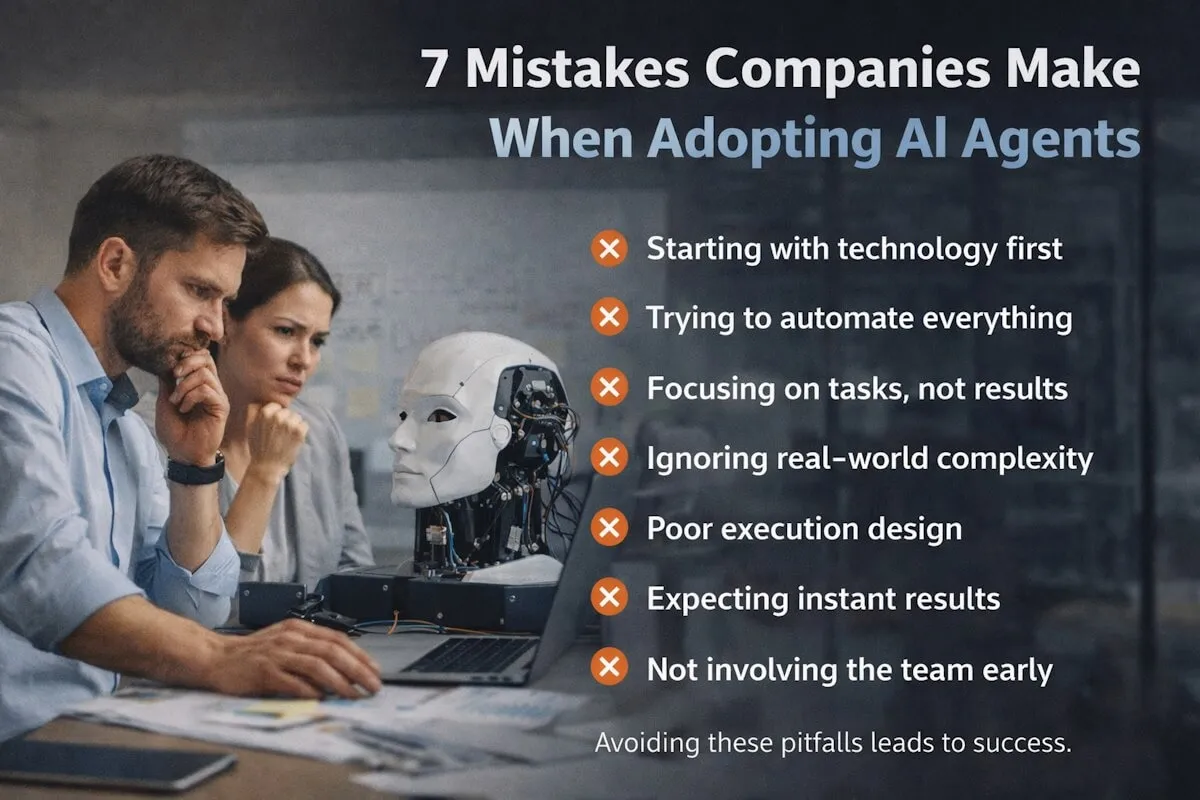
Adopting AI agents sounds like a smart move. Faster execution, less manual work, better workflows.
That’s the expectation.
But in reality, a lot of companies don’t get the results they hoped for.
Not because the idea is wrong. But because the approach is.
Small mistakes early on can turn into bigger problems later. Systems become unreliable. Teams lose trust. Projects stall.
So before you jump in or scale further, it’s worth understanding where things usually go wrong.
Let’s break down the most common mistakes.
Mistake 1: Starting with the technology instead of the problem
This happens all the time.
Teams get excited about AI agents and immediately start asking:
“What can we build?”
That’s the wrong question.
The right question is:
“What problem are we trying to solve?”
Without a clear problem, you end up building something that looks impressive but doesn’t actually help your business.
Always start with:
- A specific workflow
- A clear pain point
- A measurable outcome
That gives your system a purpose.
Mistake 2: Trying to automate everything at once
Some companies go all in too quickly.
They try to automate multiple processes across departments from day one.
It sounds ambitious. It usually creates chaos.
Too many workflows. Too many dependencies. Too many things that can break.
A better approach:
- Start with one process
- Get it working properly
- Then expand
This reduces risk and gives you faster wins.
Mistake 3: Defining tasks instead of outcomes
There’s a subtle but important difference here.
Many teams define what the system should do:
- Send emails
- Update records
- Assign tasks
But they don’t define what the system should achieve.
That leads to disconnected actions.
Instead, focus on outcomes:
- Increase response speed
- Improve follow-up consistency
- Reduce task delays
When the outcome is clear, the system can act more effectively.
Mistake 4: Ignoring real-world complexity
On paper, workflows look simple.
In reality, they’re messy.
Data is incomplete. Inputs are unclear. Systems don’t always behave as expected.
If you design your agent based only on ideal scenarios, it will fail in real use.
You need to account for:
- Edge cases
- Missing data
- Unexpected inputs
- System errors
This makes your system more reliable.
Mistake 5: Poor execution design
This is one of the biggest reasons projects fail.
Agentic systems depend on how well execution is structured.
If decision paths are unclear, the system won’t perform well.
You need to define:
- When the system should act
- What actions it can take
- When it should stop
- When it should escalate
Without this, execution becomes inconsistent.
That’s why many businesses work with Agentic AI Development Services to ensure proper system design from the start.
Mistake 6: Expecting instant results
Some companies expect immediate transformation.
They set up an agent and expect everything to improve overnight.
That’s not realistic.
Agentic systems:
- Need testing
- Require adjustments
- Improve over time
The first version is just the beginning.
Patience plays a big role in getting good results.
Mistake 7: Not involving the team early
This one gets overlooked.
Companies build systems without involving the people who actually use them.
That creates resistance.
Your team needs to:
- Understand how the system works
- Trust its decisions
- Know when to step in
Involving them early makes adoption smoother.
Why these mistakes matter
Individually, these mistakes may seem small.
But together, they can:
- Slow down implementation
- Reduce system effectiveness
- Create frustration across teams
Avoiding them gives you a much better chance of success.
What a better approach looks like
Instead of rushing, take a structured approach.
Start with:
- One clear use case
- Defined outcomes
- Proper workflow mapping
Then:
- Build gradually
- Test with real scenarios
- Refine based on results
This leads to more reliable systems.
The role of the right developers
The people building your system matter a lot.
When you Hire AI Agent Developers, you’re not just hiring for technical skills.
You’re bringing in people who can:
- Design execution flows
- Handle edge cases
- Build reliable systems
That makes a big difference in the final outcome.
A quick self-check before you move forward
Ask yourself:
- Do we have a clear problem defined?
- Are we starting with a focused use case?
- Have we mapped our current workflow?
- Are we prepared for real-world scenarios?
- Is our team involved in the process?
If the answer is yes, you’re on the right track.
The bigger lesson here
Adopting AI agents is not just about adding new technology.
It’s about changing how work gets done.
And that requires careful planning.
So, what should you do next?
Avoid the rush.
Focus on getting the basics right.
Because the difference between a successful system and a failed one often comes down to how you start.
Get that right, and everything else becomes easier.